
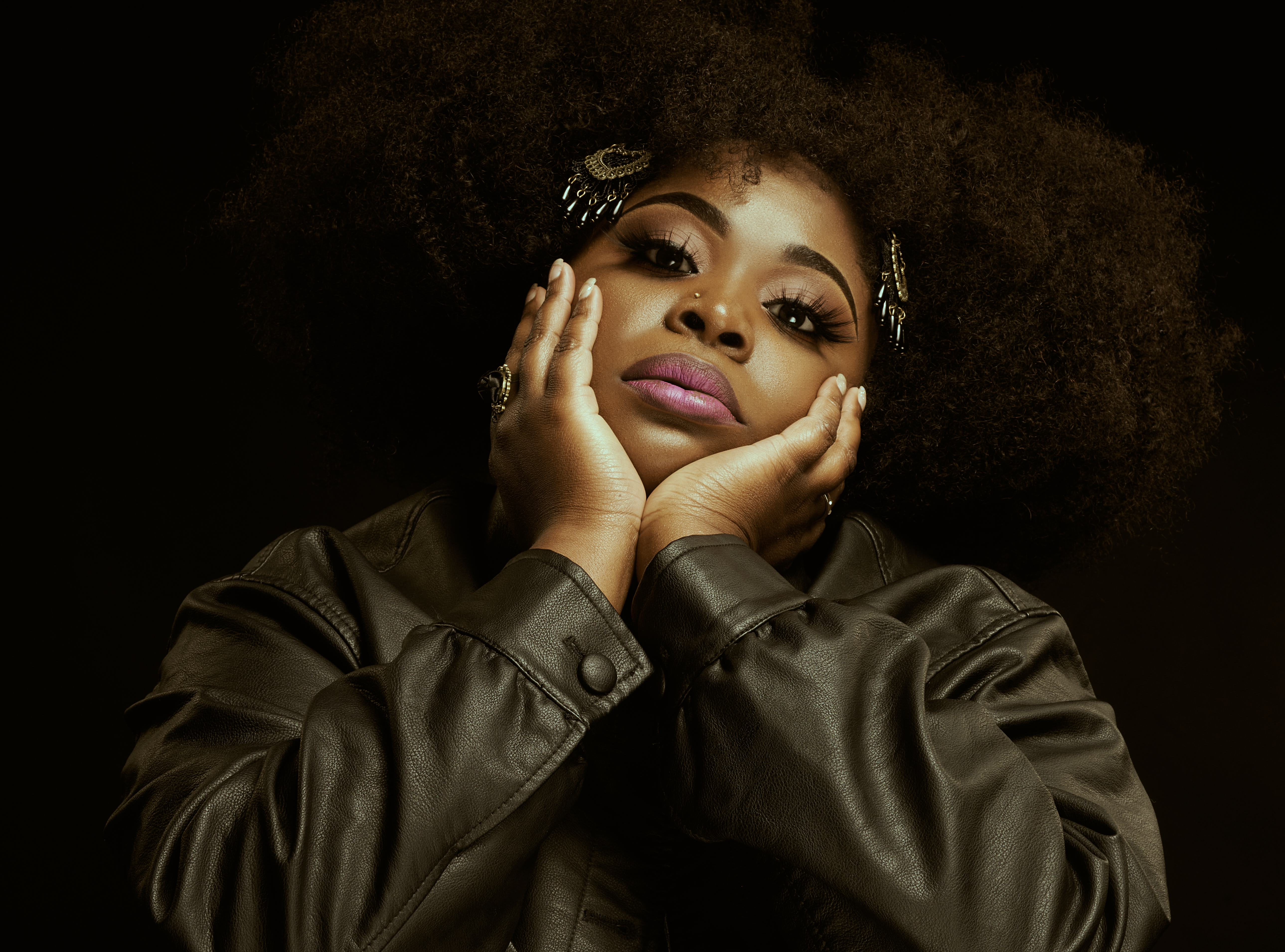
The first time I met Tarriona “Tank” Ball, I stopped her on the street because of her hair. I didn’t realize I was standing in front of the woman whose music I’d only recently discovered and whose live performance had made me an instant fan. All I knew was that this beautiful Black woman had a hairstyle I couldn’t walk past without complimenting.
We were both in Miami during Art Basel 2024, and I was still relatively new to the wonderful world of Tank and the Bangas. Months earlier, I’d discovered their music and later watched them perform at a private concert while covering an event. Something about Ball’s artistry immediately resonated with me. Her music was whimsical without being unrelatable, imaginative without losing its grounding in everyday life. Her New Orleans roots were unmistakable, right down to that inviting accent. Most importantly, she seemed entirely comfortable being herself.
In a recent conversation with Ball for I Love Us, she laughed as she remembered how it all happened. The exchange made me laugh because, even now, I’m struck by the significance of such an ordinary moment. In the middle of Art Basel, surrounded by people celebrating art in all its forms, two Black women connected on a crowded Wynwood sidewalk over an art form that has always been uniquely ours. Our hair.
As the host of the PBS docuseries Ritual, she’s helping audiences understand why seemingly ordinary moments like ours are worth examining. The series explores Black cultural traditions across the American South, tracing the histories, beliefs, and experiences embedded in practices many of us grew up knowing without necessarily understanding. Its second season includes an exploration of Black hair, an especially fitting subject for an artist whose elaborate hairstyles have become as expressive as her music.
“Hair is just so fun, and I just love that you can feel like a different person when it’s done,” Ball shared with I Love Us.
Hair is also history. It’s community, artistry, resistance, entrepreneurship, and cultural inheritance. For generations of Black women, the beauty salon has been one of the places where those histories intersect.
As the way we care for our hair continues to evolve, I’m increasingly interested in what happens to the traditions and relationships built around it.
The Beauty Shop Was Never Just About Hair

For generations of Black women, the beauty salon was more than a place to get their hair done. It was a gathering place, a neighborhood institution, and an informal extension of the family. Stylists knew their clients’ mothers and grandmothers, watched little girls grow into women, and helped prepare them for life’s milestones. Every appointment was an opportunity to catch up, exchange wisdom, and participate in a community that extended well beyond the salon chair.
Depending on the neighborhood, there were Dominican stylists perfecting roller sets and blowouts, Cameroonian braiders working intricate patterns, and girls from around the way creating finger waves and sky-high updos with enough Pump It Up to withstand just about anything. Some women traveled across cities and state lines to sit in a trusted stylist’s chair. Others welcomed aspiring beauticians into their kitchens, where a few dollars, a hot comb, and a little word-of-mouth could turn a side hustle into a thriving business.
College dorm rooms became makeshift salons, too, with enterprising students building clientele between classes. Blow dryers whirred late into the night, flat irons heated up on crowded desks, and roommates learned to sleep through the steady procession of women coming through for a silk press.
The beauty shop was also the backdrop for countless rites of passage. There were Good Friday appointments and little girls holding their ears so the hot comb wouldn’t catch them. Blushing brides preparing for their weddings, sorority sisters filling every available chair before a neophyte presentation, and somebody’s grandmother requesting the same tight curls she’d worn for decades because she liked them “just so.”
There were thick hairstyle magazines stacked beside the dryers, the unmistakable smell of spritz and Afro Sheen, and stylists insisting a client’s hair wasn’t quite dry because they needed the last little bit of tea from the woman in their chair. Braiders carried babies on their backs while singing French lullabies. Someone offered a plate of mofongo. Little girls belted out Celia Cruz or CeCe Peniston while the grown women cheered them on. Somewhere in the back, a stylist’s daughter was setting tracks with Lotta Body, preparing another client for prom.
These spaces were never culturally uniform. Different languages, nationalities, generations, and traditions existed alongside one another, each contributing something to the experience. The salon was a business, certainly, but it was also a place where women exchanged knowledge, shared resources, celebrated milestones, and participated in one another’s lives. Much of what passed between those chairs had little to do with hair, yet it was all part of the ritual.
That cultural inheritance is central to what Ball explores in Ritual. The hairstyles themselves are only part of the story. Equally important are the people who created them, the techniques passed from one generation to the next, and the communities that formed around the practice of caring for Black hair.
In the show’s exploration of Black hair, she visits locticians and salons where traditional techniques continue to be practiced, including the use of Marcel irons. She recalls encountering a third-generation hairstylist whose expertise represents a living inheritance.
“Us going into the salons of the locticians and the salons that work especially with the Marcel irons…third generation hairdressers,” Ball said. “It was an amazing episode.”
The episode, which premiered today, also examines New Orleans’ history of regulating Black women’s appearance. Ball referenced the tignon laws, which required free women of color in Spanish colonial Louisiana to cover their hair. The 1786 edict was part of a broader effort to enforce racial and social distinctions, but Black women transformed the mandated head coverings into striking expressions of individuality.
Yet, preserving Black hairstyling traditions doesn’t necessarily mean preserving the industry exactly as it once existed.
Today, conversations about pricing, appointment requirements, walk-in availability, and customer service have prompted some Black women to reconsider traditional salons and independent stylists in favor of retailers such as JCPenney and Ulta. The conversation isn’t just about whether stylists deserve fair compensation. They do. The larger concern is what happens to the community when the experience becomes increasingly difficult to access. I hope we don’t lose the relationships and rituals that made those spaces meaningful.
The Stories Hidden in Ordinary Things
One of the most compelling aspects of Ritual is its insistence that the everyday practices of Black life deserve the same curiosity and historical attention we give more formally recognized cultural traditions.
Consider the foods many Black families prepare on New Year’s Day. Black-eyed peas, cabbage, greens, and cornbread have long been associated with good fortune and prosperity. Depending on the family and region, the meal might look a little different, but the symbolism is familiar. While filming the second season of Ritual, Ball learned more about the darker history surrounding New Year’s Day for enslaved Black Americans, including the threat of families being separated through sales and transfers.
“I didn’t know that years ago, that that was actually because that used to be a dark day,” she said. “Because that was a time that [enslaved people] would be sold to other people and other owners and things like that, and families ripped apart.”
The history of New Year’s food traditions has multiple regional and cultural influences, and not every custom can be traced to a single origin. Still, the history Ball encountered gave her a different perspective on foods she’d enjoyed since childhood.
“To know the history of it was really, like, ‘whoa,’” she said.
What struck her most was the resilience reflected in the traditions.
“It’s just so amazing to see that we really do come from people of resistance and resilience and survival and, and trying to thrive after they have survived.”
Those discoveries have also encouraged her to ask questions within her own family, including about New Year’s customs and beliefs surrounding hair. It’s a practice I wish more of us would embrace.
As millennials, I sometimes worry that we’re among the last generations to remember certain traditions while also having the opportunity to question them. We’ve challenged expectations, rejected practices that no longer serve us, and reconsidered beliefs previous generations accepted without much discussion. That questioning has been necessary, but rejecting what harms us shouldn’t require abandoning everything that came before.
Younger generations have grown up in a world where many of those conversations have already happened, often without experiencing the customs that inspired them. That isn’t an indictment of Gen Z. It’s a reminder that cultural knowledge doesn’t automatically transfer simply because we share an identity. We have to tell the stories.
Ball also recognizes that preserving culture requires making room for its variations. While discussing regional differences in language and traditions, she recalled how people sometimes disagree about the names they grew up using for the same things.
“What if all y’all right? What if everybody right?” she asked. “What if I grew up calling it a frozen cup and you grew up calling it a huckabuck? Who says you wrong and I’m right?”
Her point is that differences don’t necessarily diminish our shared cultural experiences. They can reveal how traditions traveled, evolved, and took on new meanings within different communities.
“I just never want it to be a divider,” she said. “It’s just something that bring ’em together instead of tearing apart with opinions about differences.”
There is no one way to be Black, no single regional experience that speaks for all of us, and no universal version of every tradition. Preserving our culture means honoring those differences rather than insisting that one version must be the authentic one.
Black Culture Is Valuable. Preserving It Should Be, Too.
The responsibility of documenting Black culture is one thing. Finding the resources to do it is another. As a writer who has worked in digital newsrooms, I understand the pressures shaping current editorial decisions. Publications have bills to pay, audiences to attract, and revenue goals to meet. Algorithms influence which stories receive attention, and the subjects most deserving of coverage aren’t necessarily the ones most likely to generate immediate traffic. That reality can be particularly frustrating when the stories involve Black history, cultural preservation, or people whose contributions deserve recognition beyond a trending moment.
Black culture is enormously influential. Our creativity shapes music, fashion, beauty, language, and entertainment around the world. Yet documenting the histories and communities behind those contributions isn’t always treated as an equally valuable investment. It’s a contradiction Ball understands.
During our conversation, she discussed how changes in funding associated with diversity, equity, and inclusion initiatives have affected opportunities for Tank and the Bangas, particularly performances connected to Black History Month programming.
“I’ve definitely been affected by that personally within my band,” she said. “Black History Month used to be lit, you know, on the college campuses here and there, but the funding being taken away has [changed things].”
She admitted that even when you anticipate changes, experiencing their consequences firsthand can be surprising.
“Sometimes you know there’s something about to happen, but you don’t think it’s gonna hurt you or hit you like that,” she said.
Ball is grateful that Ritual secured the support necessary for a second season. Still, she doesn’t believe the absence of institutional investment should determine whether culturally meaningful work continues.
“We have to pivot, and we’ve always been pivoters, all of us. Our grandmothers taught us that. You know, our grandfathers,” she said.
She pointed to Poetry on the Porch, an experience built around her creative work, as an example of creating opportunities rather than waiting for someone else to provide them.
“We have to make it ourselves,” she said.
It’s a familiar lesson in Black communities, where resourcefulness has often been essential to survival and progress. However, our ability to create something meaningful with limited resources shouldn’t become justification for denying those projects adequate support.
Ball recognizes that artists need more than passion to sustain their work. Grants, partnerships, and other funding opportunities matter because creativity is also labor.
“We wanna live off the gift,” she said.
Even without the backing of a major media institution, she believes she would find another way to continue the work of Ritual.
“If they didn’t have it, I would still do it. I would do it in my own way,” she said. There’s something both encouraging and exhausting about that determination. It speaks to the devotion required to preserve stories that might otherwise disappear. It also raises the question of how much responsibility we’re placing on individual creators to sustain cultural work that benefits entire communities.
When Art Becomes Another Thing to Scroll Past
For Ball, the challenges of making meaningful art extend beyond funding.
There’s also the pace at which audiences consume it.
During our conversation, I mentioned how much I’d enjoyed The Last Balloon, the Tank and the Bangas album that has since earned a Grammy nomination. Ball admitted that keeping the project visible has been difficult in an industry where the promotional cycle often moves faster than the creative process.
“I’m really trying to keep it alive because it’s hard,” she said.
She described how an album might receive attention during its initial release before listeners quickly move on to something new.
“Creation is never fast. Making an album is never cheap or fast. Takes a lot of time, and work, and months,” she said.
It’s a frustration that resonates beyond the music industry.
A journalist can spend weeks researching a story that readers scroll past in seconds. A filmmaker can devote years to documenting a community whose history receives only a brief moment of public attention. An artist can pour months of creative energy into a project before audiences begin demanding another.
The speed of consumption doesn’t reflect the labor required to create.
Ball is particularly frustrated by the expectation that artists should immediately begin discussing their next project.
“I hate when people say, ‘What’s next?’” she said. “What’s next is what’s right now.”
She wants listeners to spend time with the music she’s already created, to discover the details that aren’t always apparent during a first listen.
When I asked what rituals she hoped her work might inspire, her suggestion was wonderfully simple. Listen to a Tank and the Bangas album through headphones, experience it again in the car, and then attend a live show to hear how the music transforms in performance. It’s an invitation to engage with art rather than merely consume it. That practice reflects the same curiosity that makes Ritual compelling. Sometimes, the stories we need are already in front of us. We simply haven’t taken the time to understand them.
There Is Only One You
Part of what initially drew me to Tank and the Bangas was Ball’s willingness to create without appearing overly concerned about fitting into somebody else’s expectations.
Her music builds imaginative worlds that somehow remain relatable to the ordinary experiences of millennial life. Her personality, her New Orleans accent, her sense of humor, and her unmistakable artistic identity all exist within the work.
She reminds me of something I believe deeply. There is only one version of each of us, and we have a responsibility to bring that person into the world every day. We can inherit traditions, learn from our elders, and participate in the same cultural practices as the people around us. Even if we shared every ritual we know, nobody else could replicate the lives we have created from them.
Ball has found freedom in that understanding. When I asked about making peace with the possibility that authenticity might cost her opportunities or access to certain spaces, she reflected on a lesson from her grandfather.
Growing up in church, she remembered how attendance sometimes dwindled as her grandparents got older. But her grandfather would remind her that the people who were present still mattered. “You here.”
That lesson has stayed with her throughout her career. “I know I’m not in an arena yet, but this room of people, they get it,” she said, describing the connection she feels with audiences who understand her music. For Ball, those moments offer encouragement to keep creating, even when the audience isn’t as large as she might hope.
“I find joy in it…and endurance in there to keep pushing on because somebody understands me,” she said.
Her philosophy is simple. “Make art for the ones who get it, not the ones who don’t.” It’s a perspective that connects her work as a musician to her role as a cultural storyteller.
Through Ritual, Ball is helping preserve traditions that existed long before her, while her own creative work adds something entirely new to the cultural record. That balance is what makes preservation meaningful. We aren’t responsible for becoming replicas of our ancestors. We’re responsible for understanding what they left us, deciding what deserves to continue, and contributing something of our own.
A hundred years from now, someone may wonder how we wore our hair, what music moved us, what we believed, and how we navigated the world we inherited. I hope we’ve left them enough stories to find the answers.
Watch the latest episode of PBS’s Ritual, exploring the history, artistry, and cultural significance of Black hair, and catch up on previous episodes of the series, hosted by Grammy-winning artist Tarriona “Tank” Ball, at PBS.org or through the PBS app.


Leave a Reply