
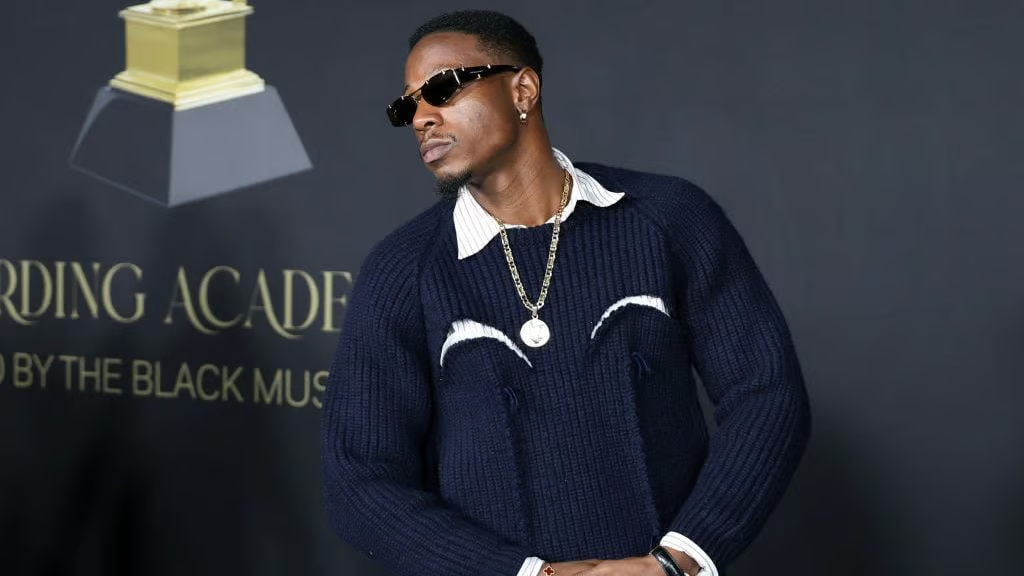
Every summer, the Recording Academy opens the doors a little wider—and in 2025, that welcome feels more aligned with the culture than ever before. Nearly 3,600 new members have been invited to join the Academy this year, signaling a deeper commitment to equity, artistry, and inclusion.
Among the new class are artists like Monaleo, Joey Bada$$, and Mariah the Scientist—Black creatives whose work continues to shape genres and challenge norms. Their invitations mark a generational shift in who holds influence behind the scenes of music’s biggest night.
A Seat at the Table—And a Say in the System
While the GRAMMYs often grab headlines for snubs and surprises, Recording Academy membership is about more than award ballots. It offers access to mentorship, advocacy, and decision-making power in an industry where Black voices have long led the culture but haven’t always had the final word.
“This is a powerful acknowledgment,” said Joey Bada$$ in a statement. “It gives me a seat at the table, not just for myself, but for the community that raised me.”
According to the Academy, this year’s class is the most inclusive yet:
- 56% identify as people of color
- 49% are women
- 60% are under age 40
Monaleo: “Music Is Sacred”
Houston rapper Monaleo, who introduced her voice to the GRAMMY audience through a performance in Hip-Hop Redefined, spoke with reverence about the honor.
“I am truly a fan and student of music,” she said. “I believe music is sacred and should be treated as such.”
For artists like Monaleo, membership is about purpose—ensuring that Black creatives are represented not only in performances and nominations, but in the decisions that shape the industry’s future.
Mariah the Scientist: “It Feels Full Circle”
Known for her ethereal, emotionally raw sound, Mariah the Scientist described her invitation as a moment of alignment.
“I’ve always made music from a real place—honest, vulnerable, mine,” she said. “Joining a space that uplifts that kind of artistry feels full circle.”
That phrase—full circle—hits hard when you consider how often Black artists have had to advocate for themselves within institutions slow to reflect the culture they profit from.
Changing the Room
This isn’t the first time the Recording Academy has touted diversity efforts—but the numbers this year suggest more meaningful progress. A majority of new members are young, nonwhite, and in many cases, independent artists who have built communities outside traditional systems.
Harvey Mason Jr., CEO of the Academy, emphasized the scope of the role: “Not only do voting members get the chance to honor their peers with GRAMMY nominations and awards,” he said, “they also gain access to mentorship, professional development, and a community shaping the future of music.”
In short: members shape the institution.
Legacy in the Making
Black music has always been a force—generating movements, shaping global culture, and challenging conventions. With the 2025 class, more of those creators are gaining access to the infrastructure that determines legacy.
While representation isn’t a finish line, it is a foundation. The Recording Academy isn’t fixed—but it’s being reshaped, one member at a time. This year, more of those members are Black, bold, and ready to change the conversation.
Cover photo: The Recording Academy’s 2025 Class Is Blacker, Bolder—And Ready to Lead / Credit: Kayla Oaddams/WireImage


Leave a Reply