
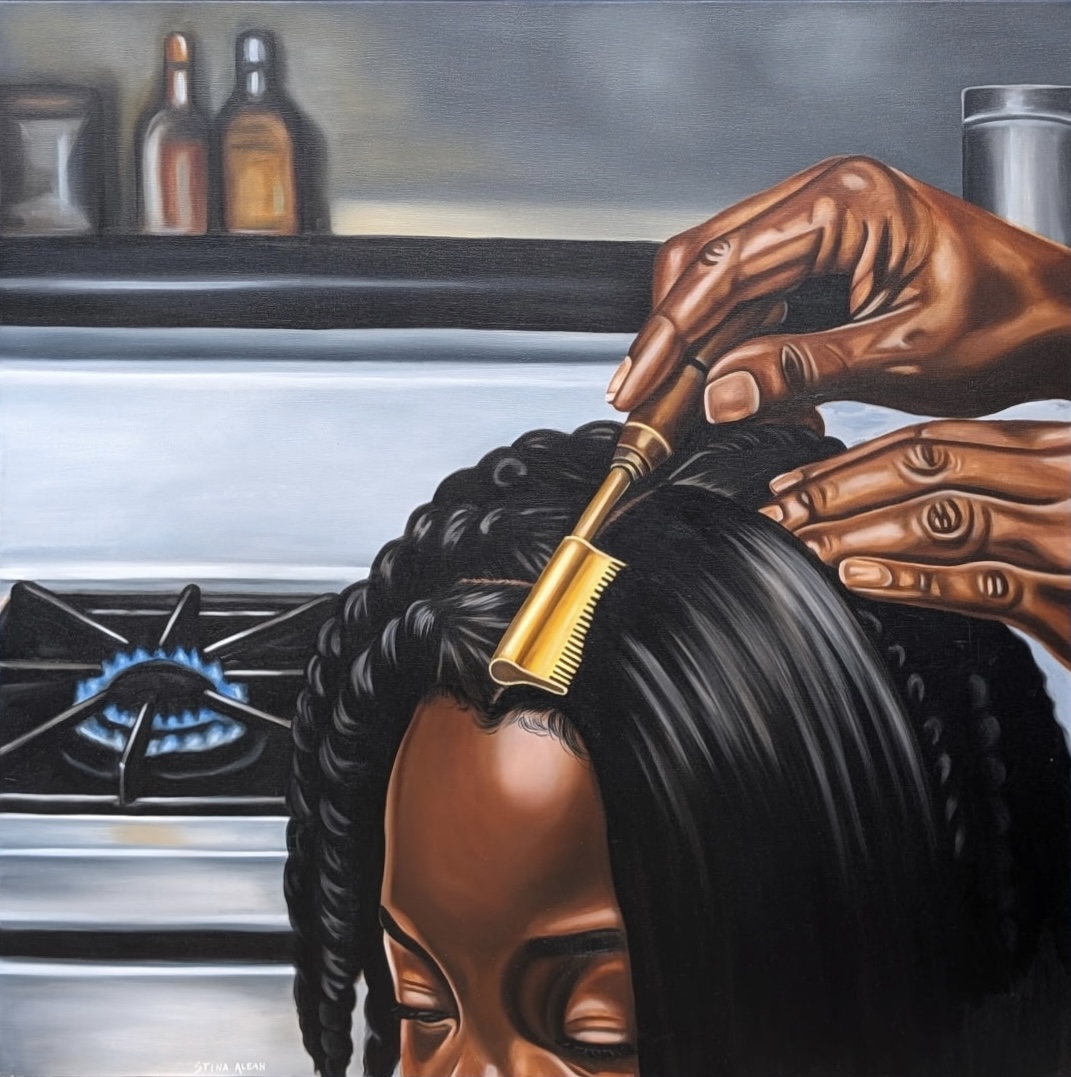
There are certain phrases that require absolutely no explanation if you grew up as a Black girl. The first time I saw Stina Aleah‘s painting Please Don’t Bump the Ends, I laughed before I even read the artist statement. The phrase itself was funny, but I also knew what was at stake.

For many Black girls of a certain generation, “don’t bump the ends” was less of a suggestion and more of a final plea. It was the last line of defense between the hairstyle you had begged for and the hairstyle you were trying desperately to avoid. It stood between the sleek, swinging bob you hoped would fall like Kyla Pratt’s on One on One and the puffed-up reality that could leave you looking more James Brown. Every Black woman I know seems to have a version of that memory.
That is part of what makes Aleah’s latest series, The Childhood I Carried, so powerful. The collection is rooted in her own experiences, yet the paintings often feel like they belong to all of us. Through familiar sayings like We Have Food at Home and Please Don’t Bump the Ends, Aleah documents something that rarely appears in official archives but lives vividly in the memories of countless Black women: the language of Black girlhood.

The eight-piece series explores the everyday moments that shape childhood, particularly the ones that often seem insignificant until years later. Rather than focusing on major milestones, Aleah centers the routines, conversations, and acts of care that many Black women recognize immediately. The result is a body of work that feels culturally collective.
Looking Back at Childhood Through a Mother’s Eyes
Aleah says the series began as she reflected on moments from her own childhood while navigating motherhood herself. What started as a personal exercise quickly became an opportunity to revisit familiar memories from an entirely different perspective.
“I started off this series by thinking about moments with my family, sisters, and friends that parallel my experience as a mother, and realized that some of these moments needed reframing and a perspective shift in looking at our mothers through the eyes of motherhood now….verses through the lens of a child,” she told I Love Us. That perspective shift sits at the center of the collection.
Many daughters grow up understanding what happened without fully understanding what it cost. Children experience care without necessarily recognizing the labor required to provide it. Hairstyles just happened as we watched “In the Heat of the Night.” Dinner is served on time each afternoon. Clothes were magically clean. Problems were solved. Much of the work behind running a household remained invisible until adulthood.
One of the most compelling examples appears in Please Don’t Bump the Ends, which Aleah says was inspired by an ordinary parenting moment that unexpectedly transported her back to her own childhood.
“In doing that I found moments like ‘Please Don’t Bump The Ends’ this painting came from actually doing my own son’s hair in the kitchen after a really long day of being on my feet, some stressful meetings, and managing a rambunctious toddler. But I stood in the kitchen and washed, detangled, and twisted his hair. It took me back to my mother…who I now know was tired…had long days, and stressful ones navigating corporate America as a black woman…I realized she showed up for me in that kitchen through exhaustion because that’s how she showed her love for me. The childhood I carried started as a way to heal my inner child, finding moments that brought forth joy instead of trauma.”
That tension appears throughout the series, creating work that examines not only what happened during childhood but also how our understanding of those moments evolves over time.
The Stories We Thought Belonged Only to Us
One of the most notable aspects of The Childhood I Carried is how frequently viewers describe feeling seen by paintings that document someone else’s life. Part of that reaction stems from the role colloquial language plays within Black communities.

For generations, Black families have passed knowledge through stories, sayings, warnings, jokes, and repeated expressions. Long before anyone talked about preserving cultural archives, many families were doing exactly that around dinner tables, in kitchens, on front porches, and during long car rides.
The phrase “We Have Food at Home” has become a social media punchline in recent years, but anyone who grew up hearing it understands there is more happening beneath the humor. The statement could mean money was tight. It could mean groceries were already purchased. It could mean a parent was trying to stretch a budget or avoid waste. It often meant a caregiver making a decision that a child would not fully understand until much later. The same can be said for countless phrases Black women carry into adulthood. Those sayings become shorthand for entire experiences. They become cultural reference points that allow complete strangers to recognize themselves in one another’s stories. Aleah’s work captures those moments without flattening them into nostalgia. The paintings acknowledge that memory can be funny, complicated, loving, frustrating, and illuminating all at once.
Painting the Images She Needed as a Child
The themes explored in The Childhood I Carried are closely connected to Aleah’s broader artistic journey. She credits painting Black faces as a major turning point in both her personal healing and creative development.
“I began to love myself more, and artistically, it continued to help me see the beauty in black and brown skin. And paint images that little black and brown girls could see themselves in as well. I wanted to give them images that I didn’t see in art when I was younger.”
That commitment to authenticity has become one of the defining characteristics of her work. It has also contributed to opportunities that have expanded her reach well beyond traditional gallery spaces, including collaborations with organizations such as the NBA, Coca-Cola, and Major League Baseball. Even as her audience grows, the work remains rooted in the same emotional honesty that inspired it.
Turning Emotion Into Art
Although viewers often focus on the finished paintings, Aleah’s process begins long before she picks up a brush.
“Usually starts with my own healing. Whether I’m anxious, dealing with ADHD, navigating a world as a neurodivergent, or just being an overstimulated mom…I start with journaling and notation, but my mind works in visuals so I usually identify an emotion and see a certain image or vision in my mind’s eye. That becomes the foundation to the work. Sketches help me refine the idea. When they are fully worked out they become my paintings.”
When asked how she balances nostalgia with truth, she rejects the notion that the two are separate.
“I think they naturally go hand in hand. Our memories are our truth; they are a part of who we are, but art remains real and felt when it is your own personal story. When you’re just painting something because it sounds cool or looks cool and trendy, people feel that. So to me it has to be YOUR truth for the paintings to really hold the emotional weight that you want your viewers to feel.”
Making Room for Joy
Discussions about Black childhood often focus on what children survived. Those conversations are necessary. They provide language for experiences that deserve acknowledgment and healing. Aleah does not dismiss that reality.
“Trauma is real, and I can never discount another person’s experiences or journey, and I’ll stand ten toes down on working those out in therapy.”
At the same time, she believes there is value in paying attention to the moments that brought joy, comfort, and connection. “But I want my viewers and my community to find joy in the moments that were often overlooked, whether that’s in the past or the present, find grace for the ones who raised us based on what they thought was best, and find peace in knowing that these moments shaped us into who we are today.”
The series is not interested in presenting childhood as flawless. It is interested in looking at it more fully. The paintings acknowledge that many of the moments we remember most vividly are not the dramatic ones. They are the moments that happened repeatedly. The phrases we heard over and over again. The rituals we participated in without thinking. The routines that seemed ordinary until we became old enough to understand what they required.
The details may seem small, but they have endured. Stina Aleah’s paintings give those memories a permanent home, preserving not only the moments themselves, but the language, care, humor, and humanity that made them unforgettable.


Leave a Reply