
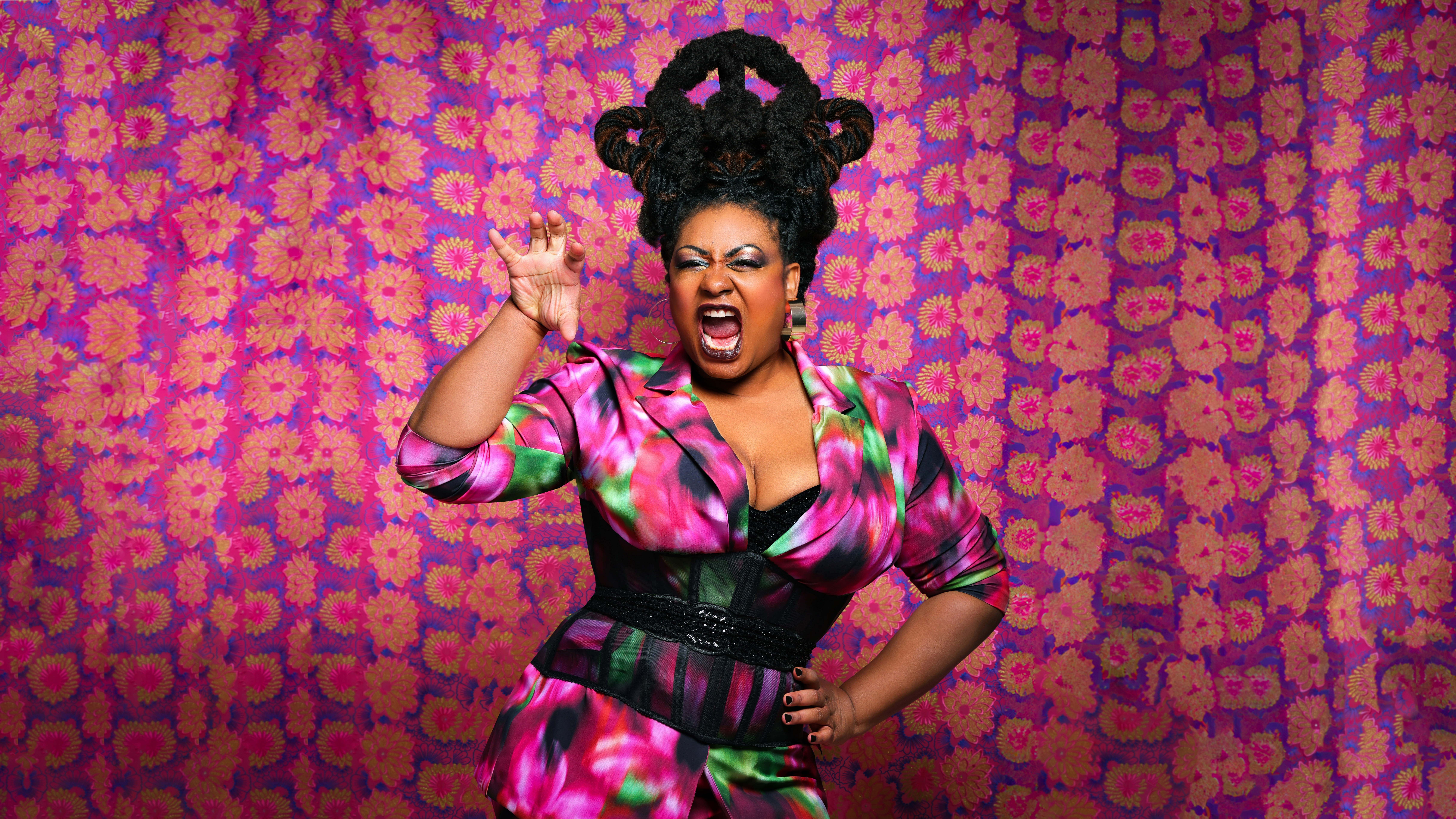
She’s been called one of the best mezzo-sopranos of this generation, and it’s not hard to understand why. Her voice is thunder and balm. It soars in Italian arias, anchors the rhythms of dancehall, and makes room for poetry by Paul Laurence Dunbar—all on the same album. Bryce-Davis isn’t just interested in accolades alone. She’s making space for Blackness in classical music that isn’t just performative, but personal.
Her debut album Evolution, released April 11 via Lexicon Classics, is her loudest offering yet.
“With Evolution, sound worlds, cultures and colors collide throughout this kaleidoscope of an autobiography,” Bryce-Davis shared with I Love Us. “This album reflects stories about my family, my roots in Jamaica, my birthplace in Mexico, my upbringing as a Black girl in a small Texas town, and my evolution into a modern opera singer.”
Recorded across five cities and three countries, Evolution features a blend of original works and genre-defying collaborations. There are classical greats like Schubert and Verdi. There’s also Jamaican dancehall legend Lady Ann, Amsterdam-based rapper Karl Wine, and Black composers like B.E. Boykin, Rene Orth, and Kamala Sankaram. It’s opera, but it’s also gospel. It’s orchestral, but it’s also hood-adjacent. It’s layered, lived-in, and fully Black.
“I’ve been yearning to tell my own stories and share the visions that are meaningful and important to me,” she says.

Singing Ella Collins at The Met
Long before she recorded Evolution, Bryce-Davis made waves at the Metropolitan Opera with her role in X: The Life and Times of Malcolm X. She portrayed Ella Collins, Malcolm’s older sister—a woman he once called “the first really proud Black woman he had ever seen.”
It was incredible to be part of X at the Metropolitan Opera,” Bryce-Davis recalls. “To see a predominantly Black cast and creative team, and for the Black community to come out in force to support—from Angela Bassett to Leslie Odom Jr.—the room just buzzed with energy and the significance of it all.”
“Her guidance helped shape him into the icon he became,” Bryce-Davis says of Collins. “That factual information is more than I have for many of the other operatic roles I sing. I’ve never been able to see direct correlations between how those ladies have shaped the history and community of my own people like I could for Ella. It was so enriching.”
How She Stays Grounded
The world of opera is not always kind to Black women. The audiences are often white. The institutions are often conservative. The spaces, as Bryce-Davis puts it, can be “solitary—or even hateful in some instances.”
Still, she shows up whole.
“Opera, when it’s great, demands that you bare your soul,” she says. “But because my career takes me to cities all over the world, the experience can feel extremely solitary—especially when I’m the ‘only one in the room’ or even the city.”
What keeps her rooted is community.
“My sisters and I meet on a video chat every morning and share how things are going… and pray together. One of my sisters is a therapist and the other is a physician. My Jamaican husband also travels with me these days, and it’s from this rich space that I head to work.”
Blackness, Unboxed
Bryce-Davis takes special interest in reminding us that Black culture already contains opera. It’s been in us.
“Blackness is not restricted to a genre or to a box,” she says. “My album is my greatest act of resistance thus far.”
Evolution includes tracks like “The Beauty in My Blackness,” “Black Rider’s Freedom Song,” and a setting of Dunbar’s “We Wear the Mask.” It also reinterprets the Negro Spiritual “Stand the Storm.” Each song pulses with purpose. This is not a singer trying to impress; it’s a woman trying to liberate.
“To exist and thrive where people don’t think you should be able to is resistance,” she says. “Creating great music in these instances is an act of resistance.”
Building More Than a Career
In 2020, amid a reckoning across arts institutions, Bryce-Davis helped launch the Black Opera Alliance—a coalition advocating for equity in classical music. What started as a collective voice for justice has become a global network of support.
“There isn’t a city in the world that I travel to where I don’t know someone from BOA,” she says. “Just today, here in Amsterdam, where I am currently for a production of the Russian opera Boris Godunov, I had coffee with a friend I connected with in the group in 2020.”
She also supports young Black artists, offering mentorship and opportunities when she can. She is aware that the next generation is watching and listening.
What Comes Next
There’s something about the clarity that comes after creating something for yourself. After carving out space in a system not built for you. After declaring that you are not a guest in this house of art—you are the architect.
“I love my career as an opera singer,” she says, “but no one can tell your story or address the truths you want to like you can. After creating my album, I feel a bit unburdened by the rules that exist. If I survived this act of resistance in this system riddled with restrictions, who knows what I’ll create or do next!”
Wherever she goes next, one thing is certain: her voice will not be tempered, and her story will not be softened. It will be sung.
Cover photo: Raehann Bryce-Davis Is Building a World Where Black Voices Lead / Credit: Isamar Chabot


Leave a Reply